Why We Exist.
Why Classics Rediscovered.

Classics Rediscovered Editorial Board, June 2026. Reviewing layout and cartography files.
We grew up believing the classics were important. We also believed they weren't written for us anymore.
Somewhere between archaic language, endless footnotes and academic translations... millions of readers stopped reading them. They became dry homework. Museum pieces. Safe.
"We decided to change that."
What We Add
Traditional editions preserve the text.
A raw reprint is beautiful, but it often remains deferred on a shelf. We bridge that distance. Classics Rediscovered builds an immersive way into the epic: integrating visual journey maps, thematic coordinates, psychological indicators, and original essays designed for the trials of modern adulthood.
Honoring and unlocking the original translation.
We do not alter, shorten, or simplify the classic text. Instead, we work with the authorized translations—supplementing them with precise mapping overlays, cross-referenced notes, and visual guides that make the original story feel as direct, intense, and immediate as it was written to be.
The Editorial Circle
We don’t believe classical literature belongs in dusty archives, nor do we believe publishing should be an automated production line. Every map, companion layer, and commentary column is prepared by scholars, historians, and designers who put their reputations behind each line.
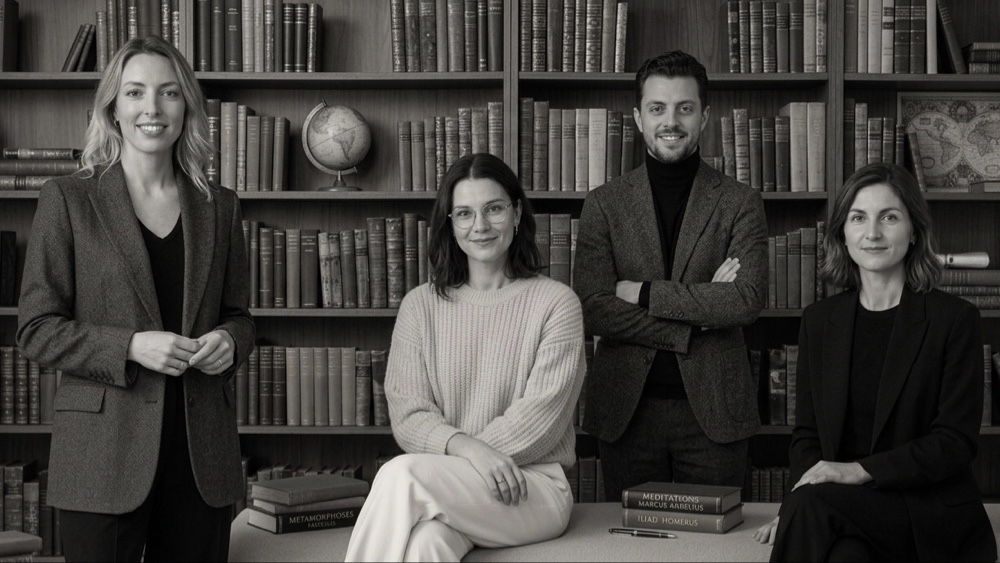
Eleanor Vance
An Oxford alumna with a PhD in Classical Philology, Eleanor is a globally recognized authority on ancient epic poetry. Her passion and deep understanding of Homeric structures form the intellectual foundation of Classics Rediscovered. Prior to joining the team, she curated ancient text translations for leading academic presses.
Sarah Chen
Drawing from her research tenure at Cambridge University, Sarah specializes in Roman Stoic philosophy and ancient rhetoric. She oversees the textual annotations and psychological essays for Marcus Aurelius's Meditations, guiding modern readers to apply ancient wisdom in contemporary life.
Michael Reed
A Yale University graduate, Michael spent over a decade as a literary critic and senior editor for prestigious cultural magazines in New York. He specializes in mapping classical narrative dynamics for the modern reader, translating archaic structures into acute psychological coordinates for active adults today.
Isabella Valentini
Born in Italy and educated at Stanford University's Digital Humanities division, Isabella spearheads our interactive reader software and digital map cartography. She bridges the heritage of fine academic publishing with state-of-the-art web tools to craft our immersive platforms.
The Library Ahead
This is not a catalogue of products.
It is a library in progress.
The Odyssey is only the beginning.
We are building a library of the works that shaped civilization—one complete, carefully prepared edition at a time.
Classics Rediscovered
The Odyssey
Homer
Volume I
The Odyssey Companion
Read Homer's legendary return. The complete epic, fully re-framed as a map of exile, disguise, and redemption.
Classics Rediscovered
The Iliad
Homer
Volume II
The Iliad Companion
The tragedy of force. Reframing the conflict of Achilles and Hector as an exploration of fury, pride, and mortality.
Join the Iliad Waitlist
"You are on the list. We will notify you when the shields of Troy are forged."
THE ANCIENT LIBRARY
THE ODYSSEY by Homer
Homecoming, identity, temptation, and recognition.
THE ILIAD by Homer
Rage, mortality, glory, and the human cost of war.
THE EPIC OF GILGAMESH Anonymous
Friendship and humanity’s earliest great confrontation with death.
THE ORESTEIA by Aeschylus
The passage from private vengeance to public justice.
THE REPUBLIC by Plato
Justice, education, power, and the construction of society.
THE BOOK OF JOB Anonymous
Suffering, innocence, and the silence of explanation.
THE ANALECTS by Confucius
Character, ritual, responsibility, and social order.
TAO TE CHING by Lao Tzu
Power without force, action without domination.
NICOMACHEAN ETHICS by Aristotle
What it means to build a good life through practice.
THE AENEID by Virgil
Exile, duty, destiny, and the price of empire.
ON THE NATURE OF THINGS by Lucretius
Matter, mortality, fear, and freedom from superstition.
THE EARLY UPANISHADS Anonymous
Self, reality, consciousness, and liberation.
THE ANCIENT CONTINUATIONS
Beginning around 170–180 AD, these texts bridge classic antiquity with early modern introspective thought.
ADDITIONAL RESEARCH CIRCLE
Workshops and textual analysis layers scheduled for downstream design consideration.
"A library is built slowly."
Each edition begins with the original work and asks the same question: what prevents a modern reader from entering it fully?
Why Reread the Classics?
At Sixteen
A student skim for facts
- Plot points: Memorizing list of names and events to clear a quiz tomorrow morning.
- Forced themes: Abstract concepts ("fate", "hospitality") pushed by textbooks without life application.
- No personal stakes: Viewed as an archaic obligation or a chore rather than a vital human map.
As an Adult
An urgent manual for survival
- Psychological maps: Recognizing that Ulysses’ temptation to stay on Calypso's island is a warning about absolute comfort destroying ambition.
- Personal stakes: Reading the second half of the Odyssey not as combat, but as the painful difficulty of being recognized by your own family after being away too long.
- Gaining coordinate systems: Finding a mature frame of reference for loss, aging, patience, and restoration.

Made for serious focus
Component 01
Clean base translation
We begin with a verified, beautiful historical translation, formatted with modern readability standards: clean layout margins and clear character divisions.
Component 02
Thematic coordinates
We inject clean highlights and sidebar notations that focus purely on core psychological, structural, and character realities, omitting academic trivia.
Component 03
Immersive cartography
Bespoke digital journey maps detailing trials, delays, and strategic pathways to ground the physical reality of the narrative.
Component 04
Modern thematic essays
Original long-form essays exploring classical themes under contemporary frames—identity loss, PTSD, cognitive resilience, and homecoming.

The Workshop — Editorial Lab
"A goddess offers him immortality and he says no. A war made him famous and he hides his name."
- Exile
- Memory
- Temptation
- Return